When performance drops in a contact center, the response is almost always the same.
More training.
Agents attend another session. A new slide deck is created. Scripts are reviewed. Policies are explained again.
The assumption is simple. If agents perform better, the problem must be knowledge.
But in most contact centers, knowledge is not the issue.
Execution is.
The Gap Between Knowing and Doing
Most agents understand what they are supposed to do.
They know the script. They know the policies. They know the steps of the process.
Yet performance still varies widely from one call to the next.
Why?
Because contact center conversations are not controlled environments.
Every call introduces new variables. A frustrated customer. A complicated question. A system issue. A policy that requires careful explanation.
In those moments, the challenge is not remembering what was taught in training.
The challenge is applying the right information at the right moment during a live conversation.
And that is much harder.
The Cognitive Load Problem
During a typical call, an agent is juggling several things at once.
They are listening to the customer.
They are searching for information.
They are navigating multiple systems.
They are trying to follow compliance requirements.
They are attempting to maintain a professional tone.
All while the conversation is unfolding in real time.
This creates a level of cognitive load that traditional training does not address.
You can train an agent on a policy. But recalling that policy quickly while managing a complex conversation is something entirely different.
The result is predictable.
Agents make mistakes not because they lack knowledge, but because the environment makes execution difficult.
Why More Training Rarely Works
Training assumes that better preparation leads to better performance.
But most contact center problems appear in the moment, not before the call begins.
A customer asks a question the agent did not expect.
A compliance disclosure must be delivered in the right context.
A conversation goes off script.
These situations are difficult to simulate in a classroom. And even if they are practiced, real calls rarely unfold the same way.
As a result, organizations continue to add training modules while the underlying challenge remains.
Agents are being asked to make complex decisions in real time with limited support.
The Real Opportunity Is Guidance
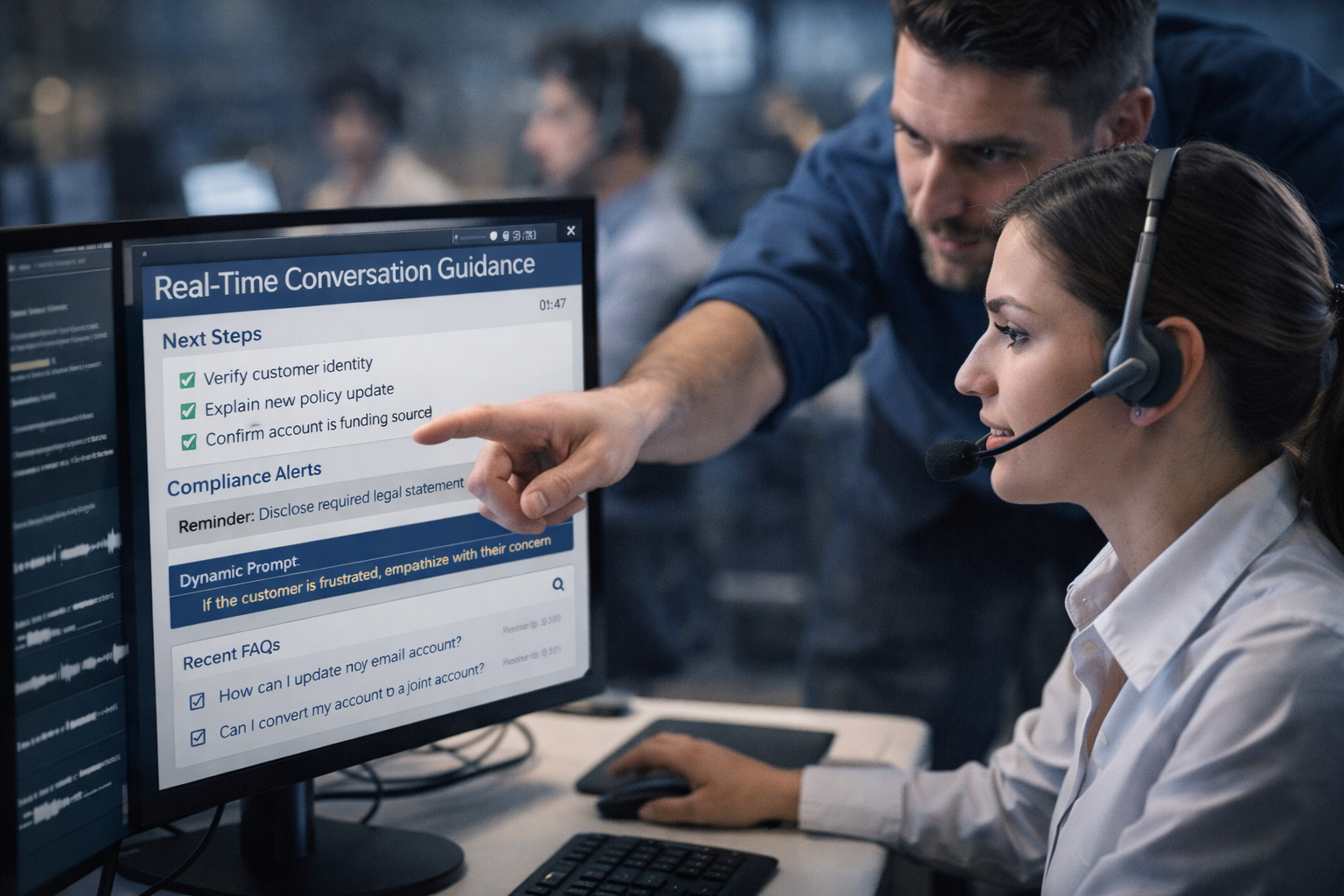
Instead of asking agents to remember everything they learned in training, a better approach is to support them during the conversation itself.
When agents receive guidance in the moment, something important changes.
They do not need to recall every policy.
They do not need to memorize every script.
They do not need to search through multiple systems for answers.
The information they need appears when they need it.
This reduces cognitive load and allows agents to focus on what actually matters.
Listening to the customer and responding effectively.
Performance Happens During the Conversation
Training will always have a role in contact centers.
New agents need to understand products, policies, and systems. That foundation is important.
But the real test of performance does not happen in training sessions.
It happens during live conversations with customers.
Improving those conversations requires more than better preparation.
It requires helping agents succeed in the moment when the conversation is happening.
And that is where the biggest opportunity for improvement still exists.