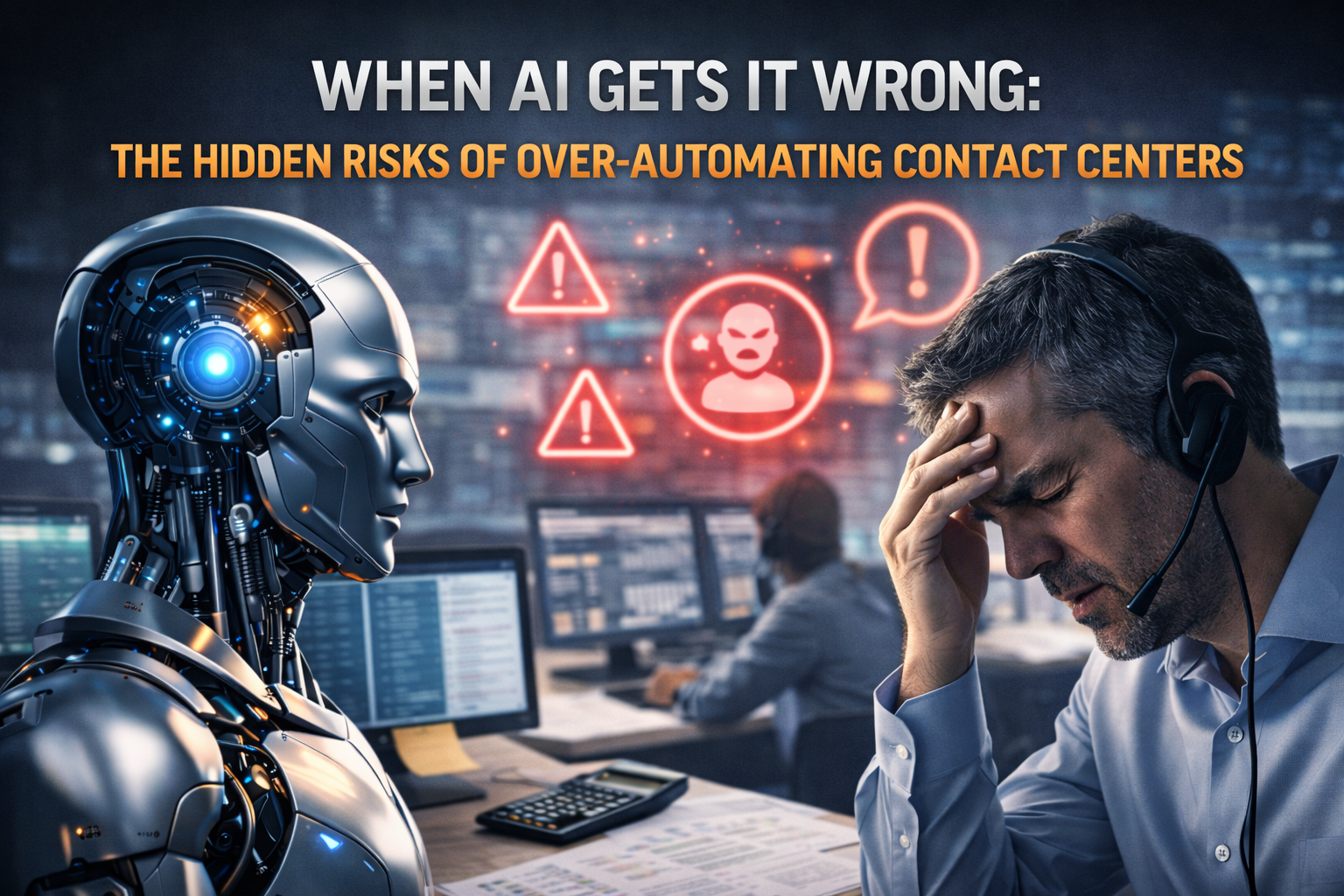
The Promise of Automation and the Problem It Creates
Artificial intelligence has become the default answer to almost every contact center challenge. Rising costs, staffing shortages, compliance pressure, and inconsistent quality all seem solvable with enough automation. The pitch is simple. Let AI listen to every call, score every interaction, and replace slow, subjective human review.
In many ways, that promise is real. AI can process conversations at a scale no team of humans ever could. It can surface patterns, trends, and signals that would otherwise remain invisible. The issue is not that contact centers are adopting AI. The issue is how much judgment they are quietly handing over to it.
Most AI systems in contact centers are optimized for speed and coverage, not for consequences. When the model is right, the system feels flawless. When it is wrong, the damage often begins quietly and grows over time.
Why AI Struggles With Real Conversations
AI evaluates language, timing, and patterns, but it does not truly understand context. It does not grasp intent, emotional nuance, or the unspoken dynamics that define real conversations. Sarcasm, hesitation, cultural differences, and edge cases often sit outside what a model can reliably interpret.
This limitation becomes especially risky in regulated environments like healthcare, financial services, and sales verification. A transcript can appear noncompliant while the conversation itself was appropriate. Another call can look compliant on paper while violating the spirit of the rules. AI sees what was said. Humans understand why it was said.
That gap is where errors begin to matter.
The Hidden Cost of False Positives
When AI incorrectly flags a compliant call, the impact is rarely immediate. Over time, however, agents begin to lose trust in the system. Coaching conversations feel disconnected from reality. Feedback becomes noise rather than guidance.
Good agents feel punished for doing the right thing. Managers spend time explaining scores they do not fully believe in. Eventually, agents disengage from the very tools designed to support them. Attrition rises, not because performance declined, but because trust did.
The Quieter Risk of False Negatives
False negatives are harder to spot and often more dangerous. AI models are trained on known patterns. When behavior changes or violations do not follow familiar scripts, those calls can pass through undetected.
The promise of one hundred percent call coverage can create a false sense of security. Leaders assume risk is being handled because every call is analyzed. In reality, the most important failures are often the hardest to detect. When those gaps surface during audits or customer complaints, the consequences are already real.
How Automation Amplifies Mistakes
The real risk emerges when AI outputs are treated as final decisions rather than inputs. Automated scores lead to automated actions. Flags turn into reports. Summaries become judgments.
Each layer of automation removes human review while increasing the impact of error. AI mistakes do not stay isolated. They scale.
This is rarely the result of bad intent. Vendors optimize for accuracy metrics, fast deployments, and compelling demos. Buyers are under pressure to reduce costs and move faster. In that environment, edge cases, audit defensibility, and agent trust are easy to overlook.
A Better Role for AI in the Contact Center
The contact centers getting this right are not rejecting AI. They are using it differently. AI is deployed to surface risk, prioritize review, and provide evidence, not to replace judgment.
Instead of binary pass or fail outcomes, they look at confidence and context. Instead of removing humans from the loop, they focus human attention where consequences matter most. AI becomes a force multiplier for good decision making rather than an invisible authority.
Automation Is Easy. Judgment Still Matters.
AI is extraordinarily powerful when used to support human decision making. It becomes dangerous when it quietly replaces it. The future of contact center AI is not about choosing between people and machines. It is about designing systems that respect the limits of automation and the value of human judgment.
The contact centers that understand this distinction will scale more safely, retain stronger agents, and remain resilient in the face of regulatory scrutiny.