Redaction has quietly become one of the most underestimated challenges in contact center technology—especially in healthcare, financial services, and other industries where sensitive information is exchanged constantly. Many vendors advertise “automatic redaction,” but few acknowledge the tension at the heart of the problem: if you redact too aggressively, you destroy the transcript’s usefulness; if you redact too loosely, you expose the organization to real compliance risk. Striking a balance between protection and readability is surprisingly difficult, and most tools fall short on one side or the other.
At MosaicVoice, we work with contact centers where even a single missed redaction can create a regulatory violation. But we also understand that transcripts need to remain clear and usable for QA reviews, agent coaching, analytics, and dispute resolution. A transcript full of black boxes isn’t a transcript—it’s a liability. This is why our approach to redaction focuses not just on removing PHI, but on preserving the meaning and integrity of the conversation.
The challenge begins with the nature of real-world speech. People rarely communicate in clean, predictable patterns. They pause mid-sentence, restart a sequence of numbers, get interrupted, or trail off. A customer might say “five-seven—hold on—nine-three—nine-three,” and a rigid pattern-based system has no idea what to do with that. On top of that, accents, background noise, and low-quality audio can cause transcription models to mishear digits or hallucinate structure. A simple misheard number can turn into a false redaction or, worse, a missed redaction. And when a system doesn’t understand the context of the conversation, you get transcripts where harmless information is removed (“Can I call you at five?” becomes “Can I call you at ###?”). The end result is a transcript that is both untrustworthy and unreadable.
MosaicVoice solves this through a layered approach designed specifically for regulated industries where accuracy matters. First, as a call is unfolding, our real-time engine identifies sensitive information in context rather than relying on rigid patterns. It understands when a caller is giving a date of birth, an insurance ID, an address, or other sensitive identifiers—even when spoken in fragmented or nonstandard ways. This real-time understanding also powers compliance coaching during the call, helping agents avoid repeating protected information unnecessarily.
Once the call concludes, a secondary model rescans the entire transcript with a deeper understanding of healthcare and financial-services terminology. This step is critical because transcription can sometimes distort numbers or speech patterns, and a second pass ensures that every piece of sensitive information is detected, even if it was spoken casually or in an unusual format. It also catches PHI related to family members, pharmacies, medical providers, and other entities that traditional keyword systems often miss.
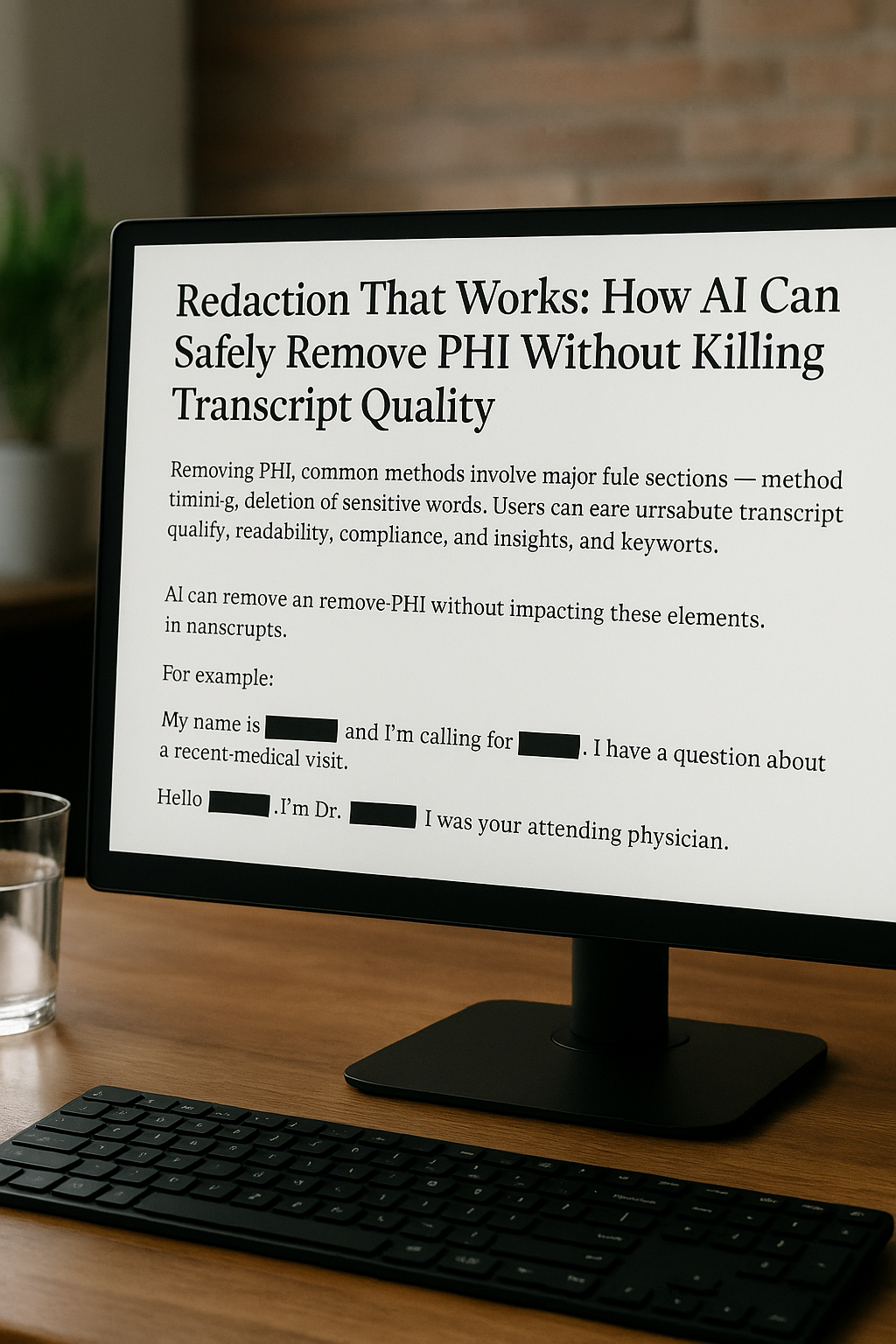
After the system identifies the sensitive fragments, it removes only the specific pieces that constitute PHI. This is a crucial distinction. Many tools attempt to redact by deleting entire sentences or phrases, which makes the transcript nearly impossible to interpret. Our method ensures that the structure, flow, and meaning of the conversation remain intact. A line like “My date of birth is July second, oh four” becomes “My date of birth is [REDACTED],” and everything around it remains untouched. Coaches, supervisors, and AI scoring systems can still interpret tone, process flow, compliance steps, and conversational effectiveness without ever seeing protected information.
This matters because redaction isn’t just a security feature; it’s a compliance strategy. When done well, redaction protects organizations during audits, ensures training materials never contain PHI, reduces exposure during customer disputes, and guarantees that downstream vendors—such as transcription or analytics providers—never receive sensitive data. When done poorly, it either leaves organizations exposed or undermines the very workflows that transcripts are meant to support.
For healthcare contact centers in particular, the stakes are high. PHI exposure is one of the most common sources of regulatory fines, and even routine operational workflows can unintentionally increase risk. A HIPAA-compliant environment isn’t achieved through one-off features—it’s achieved through a system that treats security and accuracy as inseparable. That philosophy is built into the core of MosaicVoice’s platform.
Redaction should not require organizations to choose between safety and usability. With context-aware AI, advanced entity detection, and a layered validation approach, it’s possible to achieve both. The transcript stays readable. Sensitive information disappears. Compliance risk goes down—not on paper, but in practice.
If your organization handles sensitive customer data, especially in healthcare or financial services, accurate redaction is not optional. It’s a foundational requirement. And the difference between a checkbox redaction feature and a true, defensible redaction system can have enormous consequences. MosaicVoice exists to close that gap—and to make redaction finally work the way it was meant to.