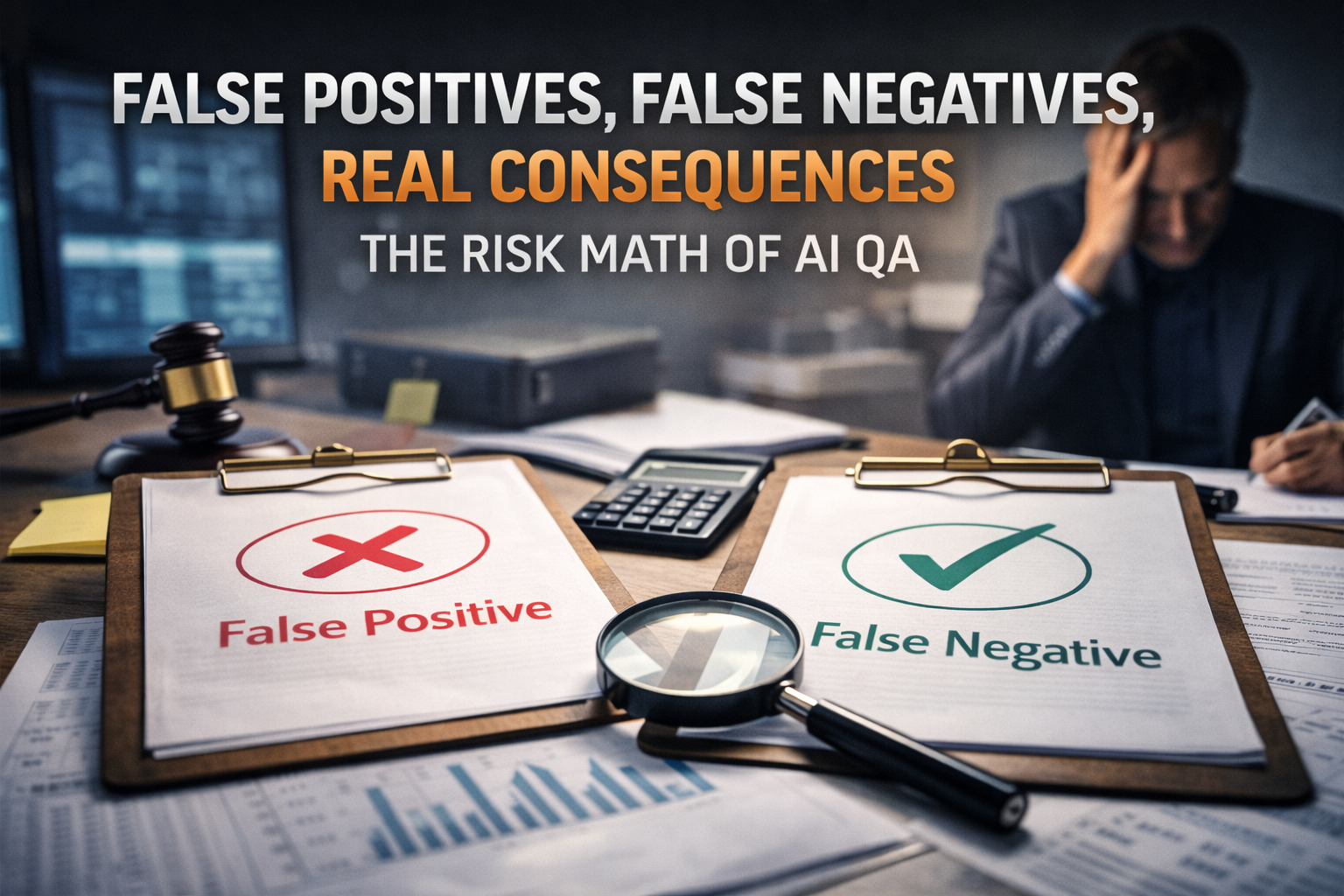
Accuracy Is the Wrong Question
Most conversations about AI quality assurance start and end with accuracy. How often does the model get it right. How closely does it match human reviewers. How high is the confidence score.
Those questions are incomplete.
In contact center QA, not all errors are created equal. A system that is ninety five percent accurate can still create serious operational, financial, and regulatory risk depending on which five percent it gets wrong. The real question is not how accurate AI is in the aggregate, but how costly its mistakes are in practice.
That is where risk math begins.
Understanding False Positives in QA
A false positive occurs when AI flags a call as noncompliant, low quality, or risky when it was not. On paper, this can look like a minor inconvenience. In reality, false positives have cascading effects.
Agents receive feedback that feels disconnected from what actually happened on the call. Managers spend time reviewing and explaining scores they do not fully agree with. Coaching conversations become defensive instead of productive.
Over time, trust in the QA system erodes. Agents learn to ignore feedback. Supervisors learn to second guess the tool. The organization ends up with more data but less clarity.
False positives are especially costly when AI outputs are tied to performance management, compensation, or disciplinary action. Even a small false positive rate can disproportionately affect top performing agents, because they handle more calls and are therefore exposed to more opportunities to be incorrectly flagged.
The Hidden Danger of False Negatives
False negatives are quieter, but often more dangerous. This is when AI fails to flag calls that actually contain quality or compliance issues.
Unlike false positives, false negatives rarely create immediate friction. Nothing breaks. No one complains. Metrics look clean. That is precisely the problem.
False negatives create blind spots. They allow problematic behavior to persist undetected. They undermine the promise of full call coverage by giving leaders confidence that risk is being managed when it is not.
In regulated environments, false negatives can surface months later during audits, investigations, or customer complaints. By the time they are discovered, the damage is already done and the opportunity to intervene early has passed.
Why Error Tradeoffs Matter More Than Accuracy
AI models are always balancing tradeoffs. Reducing false positives often increases false negatives. Tightening compliance thresholds can improve detection but increase noise. Loosening thresholds reduces friction but allows more risk through.
These are not technical decisions alone. They are business decisions.
The problem is that many contact centers adopt AI QA tools without explicitly deciding which errors they are more willing to tolerate. The tradeoffs are embedded in the model by default, shaped by training data and vendor priorities rather than operational reality.
Without intentional design, organizations inherit a risk posture they did not choose.
When Errors Start to Compound
Risk accelerates when AI outputs are treated as final decisions instead of signals. Automated QA scores become inputs to dashboards, performance reviews, and compliance reporting.
At that point, a false positive is no longer just a misclassification. It becomes an action. A false negative becomes an assumption of safety.
The scale of AI amplifies these effects. Human reviewers make mistakes, but their errors are isolated. AI mistakes repeat consistently and quietly across thousands of calls.
That is the difference between error and risk.
A More Responsible Approach to AI QA
The most effective contact centers treat AI QA as a prioritization and evidence engine, not an automated judge.
They design systems that make error tradeoffs explicit. They ask where false positives are tolerable and where they are not. They identify scenarios where false negatives carry unacceptable risk and require stronger human oversight.
Instead of binary pass or fail outcomes, they look at confidence, patterns, and corroborating signals. Instead of trusting AI blindly, they use it to focus human attention where it matters most.
This approach does not eliminate error. It contains it.
Risk Math Is Strategy, Not Engineering
AI QA will never be perfect. The goal is not zero error. The goal is to understand which errors matter, how often they occur, and what happens when they do.
Contact centers that succeed with AI are not the ones chasing the highest accuracy numbers. They are the ones that understand the real cost of being wrong.
False positives frustrate agents and erode trust. False negatives expose organizations to real harm. The balance between them defines your risk profile whether you choose it or not.
The most mature organizations choose it deliberately.